Brainerd, MN · Garage Door Service
What Actually Happens During a Brainerd Service Call
A plain breakdown of what a Brainerd garage door service call checks, why 1960s-90s housing stock and severe cold matter, and what drives the cost.
- Repairs & new doors
- Springs & openers
- Serving 8 nearby communities
The Common Mistake
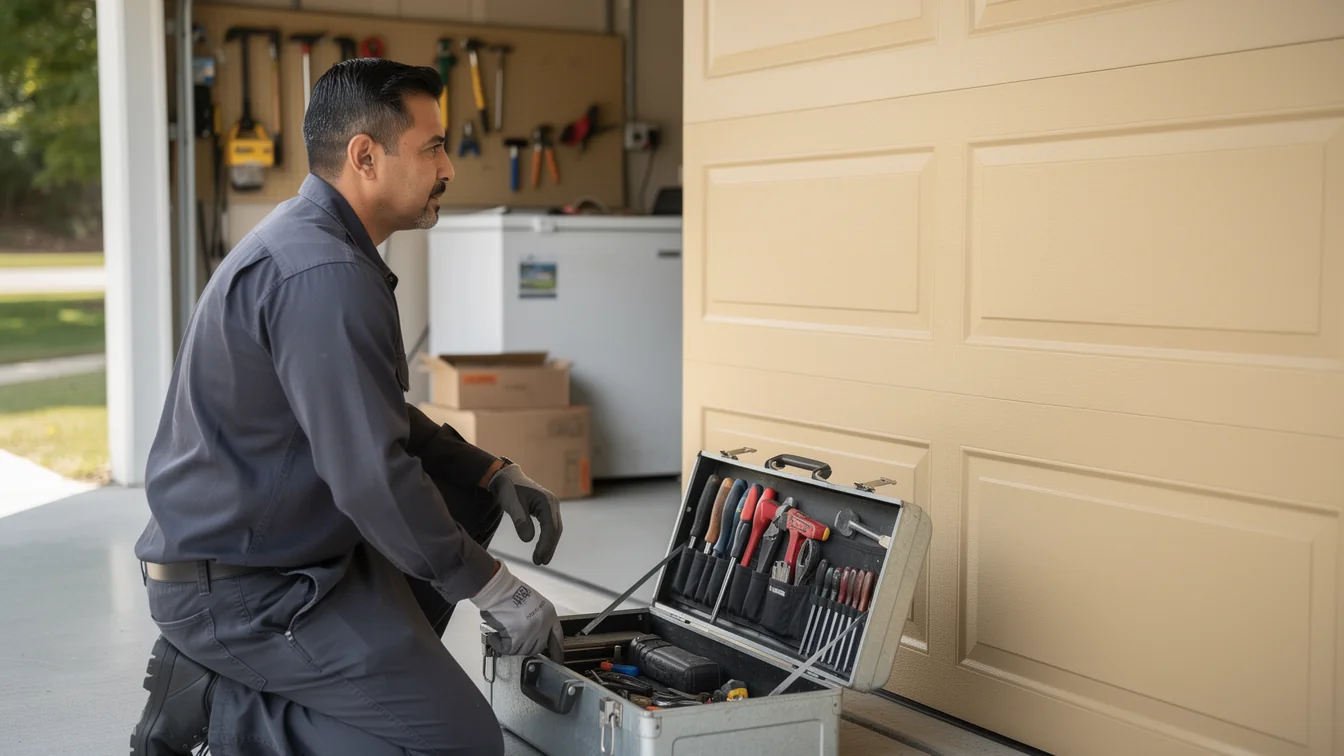
The usual mistake homeowners make is calling about one symptom - a noisy door, a slow opener - and assuming that's the whole job. Around here that's rarely true. Most houses across this service area were built between 1957 and 1999, with the median landing around 1986, which means the door, the opener, and the hardware are often three different ages layered on top of each other. Someone replaced the opener in the 2000s, the springs got swapped once after they broke, and the track is still the original. A tech who only looks at what you called about misses the part that's about to fail next. We check the whole assembly on every call - springs, cables, rollers, track alignment, opener force settings - because in homes this age, one worn part usually means a second one close behind it. That's not upselling, it's just what a door built in the Reagan era actually needs by now. The honest limitation here: if your opener is original to a house built in the late 1950s or early 60s, parts for it may not exist anymore, and we'll tell you straight if repair isn't worth chasing.
What Is Going On
Across the twelve communities we cover - Baxter, Long Lake, East Gull Lake, Nisswa, Ironton, Lake Shore, Pillager, Crosby, Deerwood, Pequot Lakes, Breezy Point, and Motley - the housing stock clusters heavily in the 1980s and 90s. That generation of garage doors was built with steel sections that weren't insulated to current standards, and torsion springs sized for lighter doors than what people have since installed over them (extra insulation, heavier panels). What we're usually diagnosing isn't a broken part in isolation - it's a spring that was correct for the door in 1988 and undersized for the door that's there now. We also see a lot of openers from the first wave of chain-drive residential units, which were solid machines but have none of the safety sensors required in newer production. Part of a service call is flagging that gap, not just fixing the symptom in front of us.
What It Costs
We don't post a flat number here because the honest answer depends on what's actually wrong - a cable off a drum is a different job than a snapped torsion spring on a double door, and both are different from an opener that needs full replacement. What we can tell you is what drives the number: the age and size of the door, whether the spring is a standard size or something a previous installer special-ordered, and whether parts for an older unit are still in production or need to be sourced. Given that median build year of 1986 across this area, we run into a fair number of doors where the original spring size isn't made anymore and we have to step up to the closest current equivalent. That's a conversation we have on-site before any work starts, not a surprise on the invoice.
How Local Conditions Play In
This area sits in a severe cold climate band, and that shapes what breaks and when. Torsion springs lose tension cycling through hard freezes, and steel contracts enough in sustained cold that misaligned track - tolerable in summer - starts binding in January. Nylon rollers get brittle with age in cold swings faster than they do in milder climates, which is part of why we see more roller failures here than you'd expect from the door's age alone. Lubricant matters too: summer-grade grease on a track or hinge turns stiff in deep cold and adds resistance right when a spring is already working harder to lift a door. A service call in this area in winter often turns up a spring that was marginal in October and failed outright once temperatures dropped. We factor the cold band into what we recommend for lubricant and hardware, not just what's convenient to stock.
Frequently asked questions
Will you just fix the one thing I called about?
We'll fix what you called about, but we check springs, cables, rollers, and opener settings on every visit first. In houses from this area's common build era - mostly 1980s and 90s - one worn part is often a sign a second one is close behind, and we'd rather tell you now than have you call again in a month.
Why does cold weather matter for my garage door?
This area falls in a severe cold climate band, and steel, nylon rollers, and spring tension all behave differently in hard freezes than in mild weather. We see more spring failures and roller cracking here in winter than the door's age alone would predict, so cold-weather lubricant and hardware choices matter.
Can you give me a price over the phone?
Not an exact one - it depends on what's actually broken, the door's size, and whether the parts are still in production. A lot of homes here have doors from the 1980s or 90s, and sometimes the original spring size isn't made anymore, which changes the job. We'll give you a firm number on-site before starting.
Related garage door services in Brainerd
More garage door guides
Book garage door service in Brainerd
Call now or request a quote - tell us what the door is doing and where you are.